

UCLA Student Volunteer
Research & Projects

A collection of research and projects created by the UCLA Food and Colonialism museum volunteer group.


Tongva Musical Instruments
By: Lily VanCleave
For the Tongva people, music was and continues to be deeply embedded in daily life as a part of ceremony, community, storytelling, and connection to the natural world. Traditionally, Tongva songs were performed with instruments made from locally gathered materials that included elder wood, bone, cane, gourds, shells, and animal hide. Musical melodies were frequently structured based on repeating rhythmic patterns.
Tongva whistles, one style of musical instrument, were crafted from bird bone, cane, or elder wood and sealed with natural gum or pitch on one end to create a clear, concentrated tone.¹ Small bone whistles were sometimes even held in one’s mouth as they sang and danced, allowing performers to simultaneously move rhythmically while adding music to their song.
Flutes, another common instrument, are typically made from elder wood or deer leg bones. Elderberry trees, which are present at Kuruvungna Springs, supplied material for instruments, tools, medicine, and even splints for injuries.² The hollow branches of elderberry were especially valued in the creation of musical instruments because their soft inner core could be cleared easily, leaving a smooth, natural tube that mirrored modern wind instruments. These flutes featured four carved finger holes to create varying pitches and tones of sound.
________________________________
¹ William McCawley. The First Angelinos. 1996.
² Kent Lightfoot and Otis Parrish. California Indians and Their Environment. Univ of California Press, 2009.
Gina Clyne, Endless Wellspring: Tongva Music and Instruments, photograph, Los Angeles Nomadic Division, August 23, 2025, https://www.nomadicdivision.org/projects-and-programs/tongva-music-and-instruments.

Where Water Sustains Life
By: Luke Whitney

Teosinte
By: Lily VanCleave
How did teosinte function in pre-contact Mexico, and how did colonization change its cultivation, consumption, and cultural meaning?
Before European contact, teosinte played a significant role in the early region that is now Mexico. The grain is considered the wild ancestor of maize and was deemed the “mother of corn.” Native to the Balsas River Valley of southern-central Mexico, its natural range did not extend beyond southern Chihuahua. Furthermore, it never grew naturally in the American Southwest. The oldest archaeological evidence for the evolution of corn points to the Mesoamerican valleys of Tehuacán and Oaxaca, where humans began selectively breeding and domesticating teosinte as long as 9,000 years ago. Teosinte typically grew wild in southern Mexico along rivers, streams, and hillsides, environments that supported early agricultural experimentation and innovation.
For culinary usage, teosinte was not widely consumed in its original form. However, long before the grain itself was cooked and eaten, archaeological evidence suggests that people first valued the plant for its sweet stalks, which were chewed for their sugary juice. The dry grain of wild teosinte was inedible because of its hard outer casing and arid texture. Only after a crucial genetic mutation reduced this tough outer shell did the kernels become edible. Ancient plant breeders intentionally replanted these more desirable kernels, gradually transforming teosinte into early forms of the domesticated corn we know today. Through generations of careful selection, this process eventually produced the maize varieties that became a staple crop across Mesoamerica.
Teosinte also held profound cultural meaning. The word “teosinte” comes from the Nahuatl term tosintli, meaning “sacred corn.” Thus, reflecting its spiritual importance. In many Indigenous belief systems, corn is regarded as the “mother of all people,” and as the ancestor of corn, teosinte is honored as the “mother of corn.” This symbolic lineage reinforced the plant’s sacred status and its connection to human origins and nutrition.
Today in Mexico, teosinte is commonly used as a forage crop for cattle, and its seeds are fed to livestock such as pigs and chickens. Despite these changes, some farmers in Mexico and Central America continue to allow wild teosinte to grow near their cornfields. They believe that genetic exchange between teosinte and domesticated corn strengthens the grain, enhancing genetic diversity and reducing the risks associated with genetic narrowing. Teosinte pollen can also cross-pollinate cultivated corn, contributing to healthier, more resilient crops.
Therefore, while colonization altered teosinte’s economic and agricultural role, transforming it from a sacred ancestor into a primary forage plant, its biological and cultural legacy endures. It remains both the genetic foundation of maize and a powerful symbol of origin in Indigenous traditions.
________________________________
“Teosinte,” n.d. Native-Seeds-Search, https://www.nativeseeds.org/pages/teosinte.
Smithsonian, “Ancient DNA Continues to Rewrite Corn’s 9,000 Year Society-Shaping History,” Smithsonian Institution, December 14, 2020. https://www.si.edu/newsdesk/releases/ancient-dna-continues-rewrite-corns-9000-year-society-shaping-history.
B. F. Benz, “Archaeological Evidence of Teosinte Domestication from Guila Naquitz, Oaxaca,” Proceedings of the National Academy of Sciences 98 (4): 2104–6, 2001. https://doi.org/10.1073/pnas.98.4.2104.
Oikos Tree Crops, The Teosinte Plant, photograph, September 6, 2023, https://www.nomadicdivision.org/projects-and-programs/tongva-music-and-instruments.

Chalkboard Illustrations
By: Katie Fang


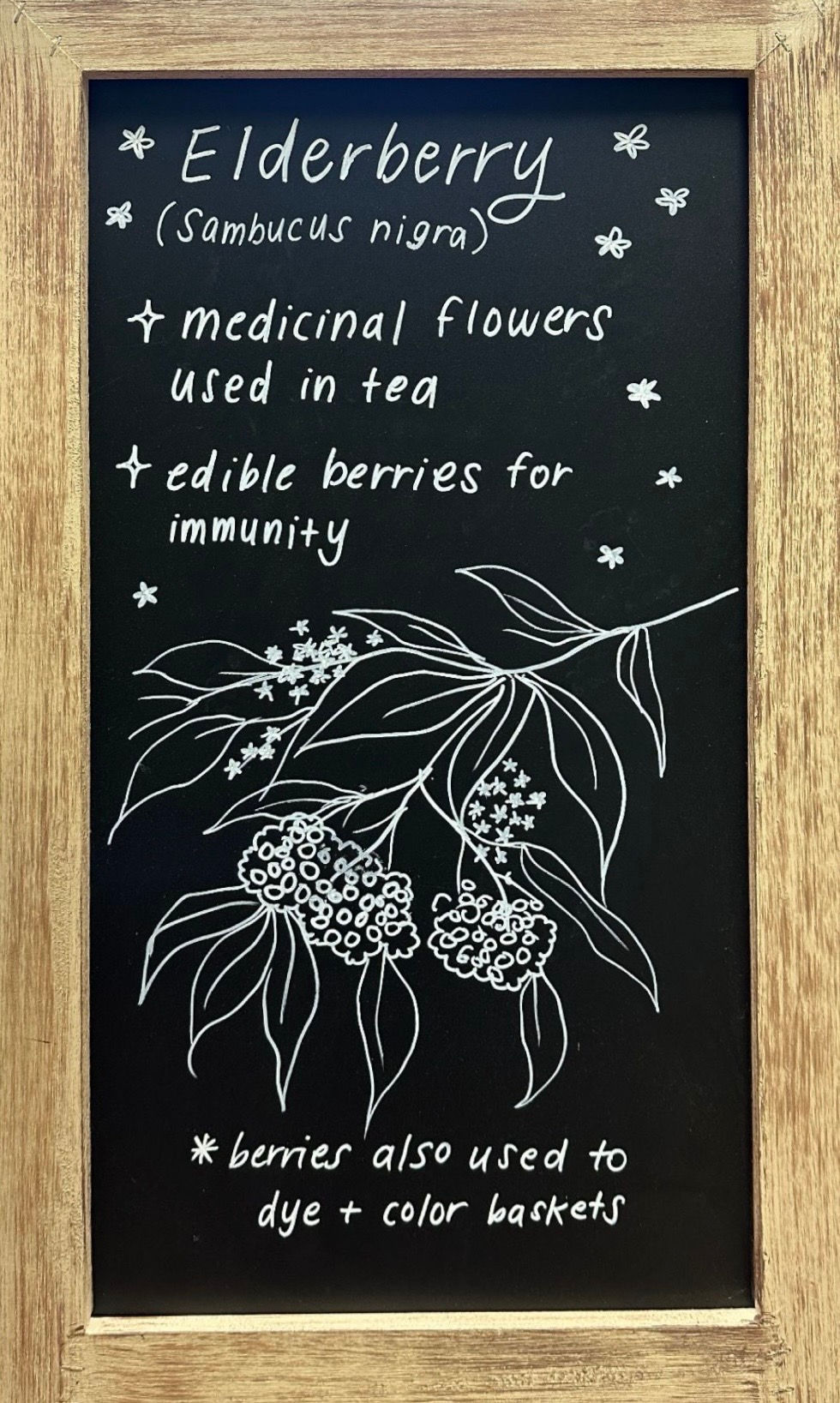
Blue Elderberry
By: Shoshana Karp
Blue elderberry, known scientifically as Sambucus cerulea, is a plant whose role in Native lifeways is incredibly diverse. To begin, the stalks are hollow and can be fashioned into musical instruments called clapper sticks as well as pipes (UCANR 2025, Brodt et al 2024). Blue elderberry, is also used not as a staple crop but as a supplemental food source in the summer months when berries can be found. Though they can be eaten fresh, they are usually dried and preserved in jellies and by other means for later consumption, including making wine (Hamel & Chiltoskey 1975, Garcia and Adams 2005). The berries could also be used to dye reeds in basket weaving processes. Some documentation also suggests that elderberries could be processed into shampoo to stave off lice. (Garcia and Adams 2005).
Elderberries were also used for medicinal purposes. When the blossoms were used to make tea, it could be administered to treat menstrual symptoms as well as the common cold, specifically to lower fevers (UCANR 2025). There is some documentation to suggest that elderberries could be processed into a paste for burns and infections on the skin. (Hamel & Chiltoskey 1975). The health of the land and the body are deeply interrelated. In order to fully enjoy the benefits offered by the elderberry, Native people used fire to steward the health of the elderberry crop within their territories. Not only did the smoke keep pests away from eating at the plant from the bark, using fire to steward the plants also ensures that the plant will continue to produce bountiful yields year after year (UCANR 2025, Brot et al. 2024). There is a strong feeling of reciprocity between plants and their human stewards. This philosophy is well encompassed in a phrase coined by Craig Torres: relatives not resources. Elderberries are given care, and in return provide health. The significance of plants is that they are thought of familially, with a similar amount of affection and care that one would regard a family member. Acknowledging the uses of the elderberry but failing to take this essential context of a millenia’s long relationship with the land into consideration is doing a disservice to the land stewardship that Native people continue to this day.
________________________________
Brodt, S., Talaugon, S., & Engelskirchen, G. (2024). When “new” crops are not really new: California Indigenous communities and research and commercialization of elderberry: The relationships of Indigenous people with the land and its plants need to be considered by non-Indigenous researchers and farmers working with native species that hold cultural significance for Indigenous communities. California Agriculture (Berkeley, Calif.), 78(3–4), 110. https://doi.org/10.3733/001c.125600
Garcia, C., & Adams, J. D. (2005). Healing with medicinal plants of the west.
Hamel, P. B., & Chiltoskey, M. U. (1975). Cherokee plants and their uses: a 400 year history. Herald Pub. Co. https://ehrafworldcultures.yale.edu/cultures/nn08/documents/003
UCANR. 2025. “Indigenous Perspectives on Elderberry Uses | UC Agriculture and Natural Resources.” UC Agriculture and Natural Resources. May 23, 2025. https://ucanr.edu/site/california-elderberries/indigenous-perspectives-elderberry-uses.

White Sage
By: Shoshana Karp
White sage, known scientifically as Salvia apiana, is an aromatic plant having an incredible diversity of uses in Native contexts. To begin, like all plants, it is important to harvest the sage ethically so that the plant can continue to thrive after taking some for use. The seeds are used as a staple food throughout the warmer part of the year known more commonly as chia. To overharvest and weaken the abundance and health of the crop would only harm Native communities in the following year. For that reason and many others, white sage is handled with the utmost care.
White sage is also used for spiritual, medicinal and community building practices. Yet, the significance of the plant goes deeper: it is a sacred plant. White sage lives at the intersection between spirituality and healing. It is known as a potent herb, spiritually and medicinally. To burn it is to cleanse the spirit, in a process called smudging. The smoke is used to bless people, especially the sick. Adams (2005) says that “when white sage is smudged, everyone should be praying.” The person smudging usually prays to wash away any negative energy associated with the person they are blessing. He goes on to say that prayer is a vital part of the healing process with no risk, which is why the white sage is burned. It is believed that “the smoke brings the prayers to God. The smoke also incites God to participate in the healing process,” Adams and Garcia 2005). The spiritual potency of white sage in Native conceptions of medicine and the spirit cannot be understated. The land, the spirit and the body are thoroughly intertwined. If the land is sick, the spirit and body will become sick. White sage is also a physical signal of community health as it is often used as a gift. It is a sign that you care for the spiritual and physical health of the one that is receiving it.
Medicinally, is it thought to boost the efficacy of other herbs when used in tinctures or teas together (Krol et al. 2021). There are many different uses for white sage. Traditionally its most widely accepted use is to ease sore throats and treatment for head colds (Adams and Garcia 2005). It has other uses, especially meaningful to women. It was also used alongside other herbs to promote healing afterbirth, as well as easing pain. (Krol et al. 2021). In larger, more potent doses it can also induce vomit. In a pharmacological review by Krol, Kototliewitz and Luczkiewicz, the chemical compounds of white sage were evaluated using biomedical research methods. The efficacy of using white sage in these was preliminarily confirmed with these methods and also found white sage to contain some ability to stave off pancreatic and colon cancer, has antibacterial and antifungal properties, lowers mucus, sweat, and saliva production among other things. Though biomedical methods are often touted as being the most reliable, remedies that have existed within Native communities for years have been kept in their medicinal traditions for a reason.
Fortier cites an indigenous woman, “Gonzales explained that white sage is considered sacred, partly because it has so many uses,” (Fortier 25). For Native groups these categories are not distinct from one another. Native lifeways have vastly different modalities and priorities than that of the Western world. That doesn’t make their knowledge any less valid than knowledge whose origin is biomedical or coming from a scientific tradition.
________________________________
Adams, J. D., & Garcia, C. (2005). The Advantages of Traditional Chumash Healing. Evidence-based complementary and alternative medicine : eCAM, 2(1), 19–23. https://doi.org/10.1093/ecam/neh072
Fortier, J. Native American Consultation and Ethnographic Study, Ventura County, California.
Garcia, Cecilia, and James D Adams. 2012. Healing with Medicinal Plants of the West : Cultural and Scientific Basis for Their Use. La Crescenta, Calif.: Abedus Press.
Krol, A., Kokotkiewicz, A., & Luczkiewicz, M. (2021). White Sage (Salvia apiana)–a Ritual and Medicinal Plant of the Chaparral: Plant Characteristics in Comparison with Other Salvia Species. Planta Medica, 88(8). https://doi.org/10.1055/a-1453-0964
